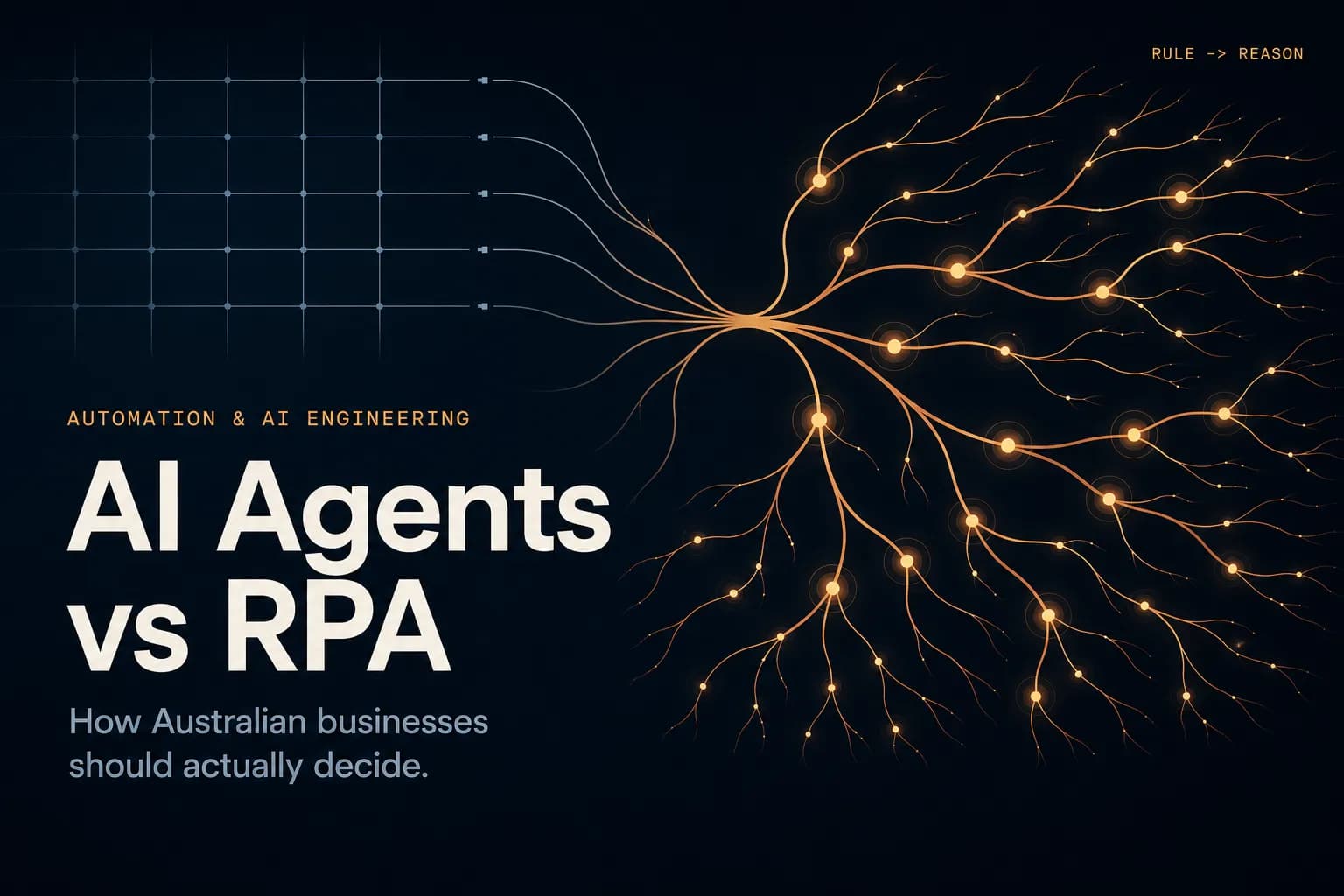
“Traditional automation (RPA) follows fixed, rule-based scripts and breaks the moment a process varies from what it was programmed to expect. AI agents interpret unstructured inputs, make judgment calls within boundaries you set, and escalate what they can't handle, which is why they keep working when a document, request, or workflow doesn't fit the pattern. The right answer for most Australian businesses isn't "replace RPA with AI agents." It's knowing which processes need which tool, and that decision comes down to two things: how much your process varies, and how much it matters when something goes wrong.”
“That second part is the piece most comparisons skip. If you're in aged care, disability services, agriculture, or real estate and construction, an automation failure isn't just an annoying re-run. It's a missed compliance deadline, an unlogged decision, or an answer you can't show your source for. That's the lens this article uses, because it's the one that actually determines which technology you need.”
What's the real difference between RPA and an AI agent?
RPA is deterministic. It clicks the same buttons, reads the same fields, and follows the same if/then logic every time, which makes it fast, cheap to run, and predictable, as long as the input never changes shape. An AI agent is built on a large language model, so instead of following a script, it reasons about what it's looking at: it can read an unfamiliar document layout, weigh several possible actions, call the right tool or API for the situation, and decide when a task is outside its remit.
Neither approach is inherently better. RPA remains the right call for a stable, high-volume, structured task: nightly data reconciliation between two systems that never change format is still a textbook RPA job, and it usually runs cheaper than an LLM-backed agent doing the same thing. The question is which category your process actually falls into.
Can RPA handle exceptions the way AI agents do?
No, and this is the part worth sitting with rather than skimming past. RPA doesn't fail occasionally on exceptions; it's architecturally incapable of handling them, because an exception is by definition something outside the rules it was given. A bot built to extract three fields from a supplier invoice will stop, error out, or silently misfile the record the moment a supplier changes their template, sends a scanned PDF instead of a native one, or includes a line item the bot's rules never anticipated. Someone has to notice the failure, diagnose it, and either fix the bot's rules or process the exception by hand. That manual cleanup work is exactly what the automation was supposed to remove.
An AI agent handles the same situation differently because it isn't matching a template, it's reading and reasoning about content. It can recognise that a document is still an invoice even in an unfamiliar layout, extract the fields correctly, and, critically, flag the cases where it isn't confident, routing those to a person instead of guessing or crashing silently. This is the design principle behind our AI agent development work: every agent operates within defined boundaries, and when it hits something outside its confidence threshold, it escalates to a human rather than acting on a bad guess. That escalation path, not raw autonomy, is what actually makes an agent safe to run unattended.
Why does this matter more if you're in a regulated industry?
For a low-stakes internal task, an RPA bot silently failing on an edge case is annoying. For an NDIS provider, an aged care operator, an agribusiness managing export compliance, or a real estate agency handling lease obligations, the same failure mode is a different order of problem. These industries don't just need a task completed. They need to be able to show, after the fact, what happened, why, and on what basis. A rule-based bot that errors out on an unusual case leaves you with a gap and no explanation. An AI agent that hits the same case can reason through it, act within the guardrails it's been given, and log exactly what it did and why.
This is where the difference stops being theoretical. Our case study on Nexa AI, our RAG-powered legal assistant for ACT tenancy law, is a concrete example of what this looks like in practice: rather than a static FAQ or a rule tree that breaks on an unusual tenancy question, Nexa retrieves the relevant sections of the actual legislation, reranks them for relevance, and generates an instant, accurate, and cited response, so the user (and, if it ever needs reviewing, the business) can see exactly which section of the Residential Tenancies Act the answer came from. That combination, handling a question that doesn't fit a fixed script and being able to show your source afterward, is precisely what RPA cannot do and what a properly built agent can. It's the same principle behind the AI integration and automation work we do for Sydney businesses: every agent action gets logged with a full audit trail, so the compliance case for using AI doesn't rest on trust alone.
Do you have to choose one or the other?
For most businesses, no. Treating this as a single either/or decision is where a lot of automation strategy goes wrong. The realistic picture for a mid-sized Australian business is a mix: RPA running the stable, structured pieces of a workflow, with an AI agent handling the judgment-heavy step RPA was never built for. A common pattern is RPA extracting and moving structured data, then an agent reviewing the result, deciding whether it needs human sign-off, and routing it accordingly, each tool doing what it's actually good at.
Where businesses tend to get this wrong isn't the technology choice, it's sequencing: building agents before mapping which processes are stable versus variable, or before understanding where compliance exposure actually sits. This is the gap our AI strategy consulting work is built to close: a readiness assessment scores your processes, data, and risk exposure before anything gets built, so the RPA-versus-agent decision is based on how your business actually operates, not a generic framework.
How do you actually decide which one to build first?
Two questions do most of the work. First: how often does this process vary in a way a fixed script can't anticipate (a new document format, an unusual customer request, a regulation that changes mid-year)? The more variation, the more the case tilts toward an agent. Second: what's the cost of getting this wrong, and does someone outside your business ever need to see how a decision was made? The higher the compliance stakes, the more the audit trail and reasoning transparency an agent provides start to matter more than raw processing speed.
If you're not sure how your own processes score on either axis, that's a discovery problem before it's a build problem. An AI ROI Discovery engagement is built for exactly this: a focused engagement that maps your highest-value automation opportunities and gives you a go/no-go business case before you commit budget to either an RPA bot or a custom agent, so you're not guessing which one earns its cost.
If you're trying to work out whether a process in your business needs RPA, an AI agent, or both, talk to our team. We'll help you map it out before you spend a dollar building the wrong one.



.JPG)