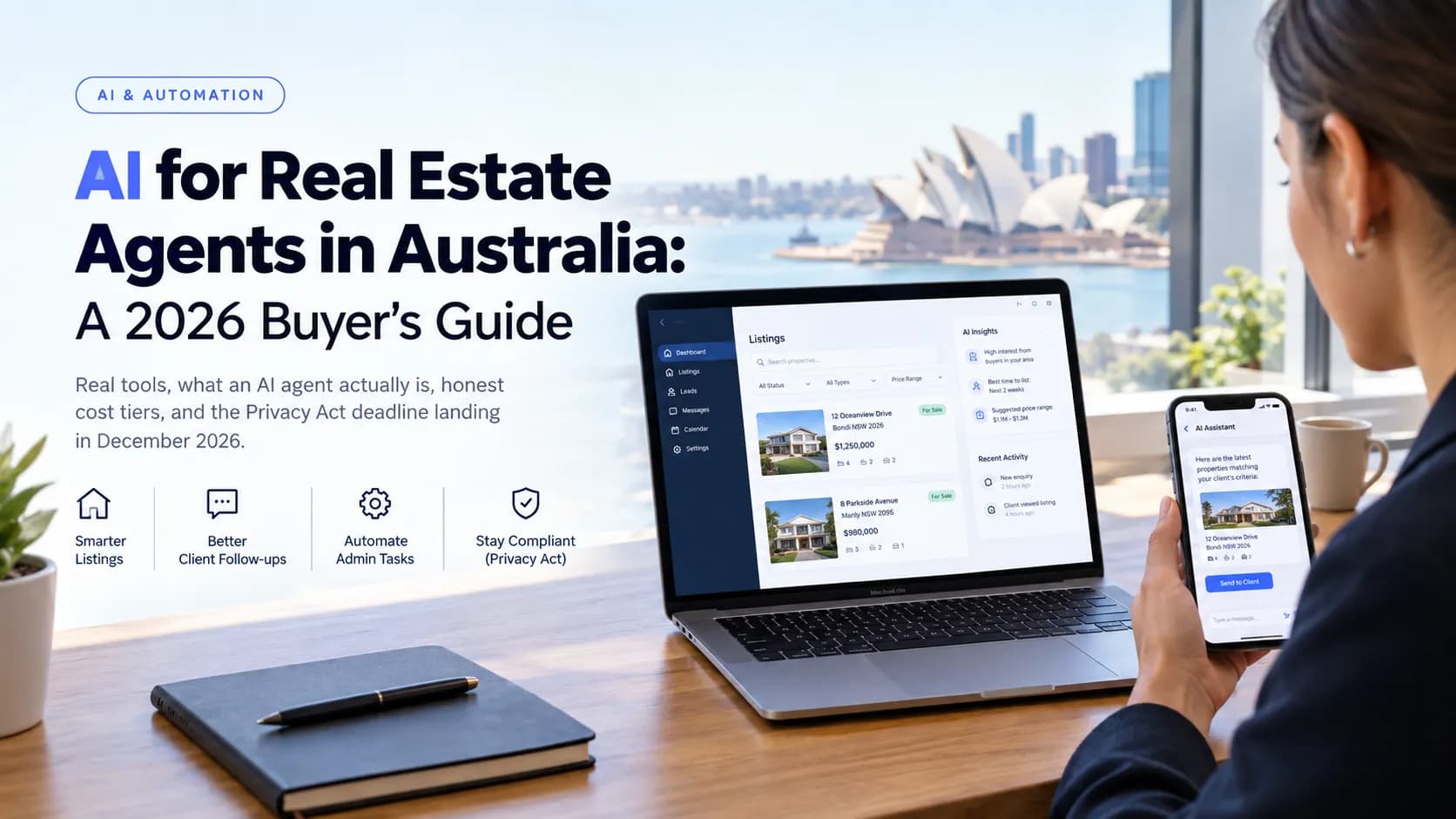
The Australian real estate landscape in 2026 is defined by a paradox: record-breaking property values paired with an unprecedented administrative breaking point. As the median house price in Sydney climbs toward $1.7 million and rental vacancy rates in cities like Perth and Brisbane remain at historic lows, the sheer volume of data, inquiries, and compliance hurdles has overwhelmed the traditional agency model. For years, agencies relied on property management software Australia that functioned as little more than digital filing cabinets. These tools stored information, but they required a human to move every single lever.
Today, the industry is shifting toward "Agentic AI." Unlike standard automation, which follows a linear "if this, then that" logic, AI agents act as digital teammates. They reason, they triage, and they execute complex workflows autonomously. At Beyond Himalaya Tech, we are seeing a mass migration as principals realize that scaling an agency in 2026 no longer requires hiring more staff: it requires deploying better engineering.
The Administrative Crisis: The Invisible Cost of Property Management Turnover
The average Australian property manager is currently drowning in a sea of "micro-tasks." Recent data from May 2026 shows that over 40% of Australian real estate professionals cite administrative burnout as their primary reason for leaving the industry. A typical afternoon for a property manager involves juggling hundreds of "Is this still available?" inquiries, chasing late rent via manual SMS, and coordinating with tradespeople for minor repairs.
This administrative bloat is the "silent killer" of agency profitability. When your most talented staff members spend 60% of their week on data entry and lead qualification, they cannot focus on the high-value activities that actually grow the rent roll: strategic asset management and landlord relationship building. Legacy real estate software Australia has failed to solve this because it lacks context-aware intelligence. It can send a reminder, but it cannot handle a tenant's nuanced reply about a delayed bank transfer or a complex repair request. This is where AI integration services Australia move from a technological curiosity to a mechanical necessity for survival.
5 High-Impact AI Use Cases for the Modern Australian Agency
To dominate the market in 2026, agencies must move beyond "AI-wrapped" tools and implement native agentic workflows. Here are the five areas where our engineering team is delivering the highest ROI for our clients.
1. Hyper-Local Conversational Lead Triage
The "Is this still available?" inquiry is the bane of an agent's existence, yet it is the first touchpoint for a future client. Modern AI agents are trained on your specific portfolio and hyper-local suburb data. In 2026, an agentic system does not just send a generic link: it answers specific questions about school catchments in Canberra or public transport proximity in Melbourne's inner-west. It qualifies the lead by checking their rental history against your criteria and automatically books a viewing directly into the agent's calendar. Agencies using this level of triage have reported a 68% reduction in time spent chasing cold leads.
2. Visual Maintenance Triage and Predictive Scheduling
Maintenance coordination is historically the largest source of friction in property management. By integrating AI agents into the tenant portal, agencies can now offer "Visual Triage." When a tenant uploads a photo of a leaking tap, the AI analyzes the image, identifies the likely fixture type, and cross-references it with the property's warranty status and the landlord’s pre-approved contractor list. The agent can then draft the work order and alert the landlord with a single click. This "Predictive Property Management" reduces long-term repair costs by identifying issues before they become structural failures.
3. Real-Time Dynamic Appraisals and Market Forecasting
Traditional appraisals rely on lagging data from the previous quarter. In a market as volatile as 2026 Australia, a three-month-old data point is a liability. Our AI systems utilize Retrieval-Augmented Generation (RAG) to pull real-time data from multiple property portals, local government planning announcements, and even infrastructure project timelines. This allows your agents to provide landlords with "Forward-Looking Appraisals" that account for upcoming train line extensions or new commercial developments. This shifts the agent’s role from a "data provider" to a "high-level investment consultant."
4. Automated Inspection Narratives and Compliance Monitoring
Property inspections are time-consuming, but the reporting is where the real bottleneck exists. Agents in 2026 are using voice-to-report automation where they simply narrate their findings into a mobile device during the walkthrough. The AI then structures this narrative into a professional, formatted report that highlights urgent repairs and compares the current state of the property to the initial condition report. Furthermore, the AI monitors these reports for compliance with the latest 2026 rental law overhauls, ensuring every notice period and minimum standard is met to protect the agency from legal liability.
5. Tenant Sentiment Analysis and Churn Prevention
It is five times more expensive to find a new tenant than to keep an existing one, yet most agencies are reactive rather than proactive. AI agents can monitor communication patterns across your entire portfolio. If a long-term, high-quality tenant begins expressing frustration over repeated minor issues, the system flags them as a "Churn Risk." This gives the agency principal a "Head Start" to intervene, resolve the friction, and prevent a vacancy, directly protecting the landlord's yield and the agency's management fees.
Case Study: Dominating the SERP via the Write-to-Rank Framework
Engineering great AI is only half the battle: the other half is ensuring the market knows you have it. This is why Beyond Himalaya Tech (BHT) pioneered the Write-to-Rank framework. We realized that many Australian agencies were investing in great technology but failing to rank for the keywords that matter because their content was too thin or lacked "Entity Proof."
When we applied this framework to our own reputation management and SEO automation projects, we focused on building deep topical authority. For a real estate agency, this means more than just having a website: it means being the primary source of truth for your local market.
Our internal data shows that by utilizing the same multi-agent systems we build for clients to automate our own SEO research and content optimization, we have proven that a data-driven content strategy can outrank older, larger competitors who rely on generic marketing. For an agency, this framework ensures that when a landlord searches for "best property management in Melbourne," your firm is not just a result: it is the cited authority recommended by AI search engines like Gemini and Perplexity. This is a core component of our custom software development Australia philosophy: we build for both humans and the generative engines of the future.
The 2026 Evaluation Guide: How to Spot "AI-Washed" Software
As the demand for workflow automation software Australia grows, many legacy providers are simply adding a basic "chat" button to their existing products and calling it AI. To protect your agency's investment, you must evaluate technology through an engineering lens.
Agentic vs. Linear: Does the software just send an automated email (Linear), or can it reason through a multi-step problem like negotiating a repair date between three different parties (Agentic)?
Local Data Residency: In 2026, data privacy is a legal minefield. Ensure your AI partner prioritizes Australian data residency to comply with the latest Privacy Act amendments.
Integration Depth: True AI should not be another tab on your browser. It should live within your existing CRM and accounting tools, acting as a "Digital Operator" that reconciles data across all your systems.
Human-in-the-loop (HITL): Reliable AI must have clear "Override Paths." The system should handle 80% of the volume but know exactly when to escalate a complex emotional or legal issue to a human agent.
Frequently Asked Questions for Australian Agency Principals
Is AI going to replace my property managers?
The data from 2026 is clear: AI is not replacing agents, but agents who use AI are replacing those who don't. The goal is to automate the "robotic" work so your staff can focus on the "human" work: negotiation, empathy, and strategic growth.
How much does it cost to implement a multi-agent system?
While basic tools are cheap, enterprise-grade AI agents for Australian businesses typically range from $40,000 to over $150,000 depending on the depth of integration with your legacy platforms. However, the ROI is usually realized within six months through reduced overhead and increased staff capacity.
Is our data safe from being used to train global AI models?
At Beyond Himalaya Tech, we build with "Privacy by Design." We use private instances and secure API layers to ensure your agency’s proprietary data is never leaked into public training sets. Your data remains your competitive advantage.
What is the first step to getting started?
We recommend starting with an "AI Road Map." This is a comprehensive audit of your current workflows to identify exactly where AI can deliver the fastest win: usually in lead qualification or maintenance coordination.
Conclusion: The Future of Your Agency Starts with Engineering
The transition to an AI-first agency is no longer a futuristic concept: it is the current reality of the Australian market in 2026. Agencies that continue to rely on manual processes and legacy real estate software Australia will find themselves unable to compete with the efficiency and responsiveness of agent-led firms.
I have seen the transformative power of moving from "software" to "intelligence." We do not just build websites: we build the digital infrastructure that allows your agency to scale without the burnout.
Are you ready to move your agency beyond the limitations of legacy software? Connect with us to begin your AI Road Map and lead the 2026 real estate evolution.


.png&w=3840&q=75)

.JPG)